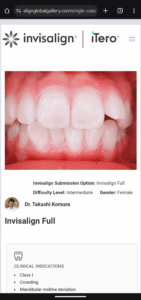
インビザライン(クリアアライナー)治療では、上顎側切歯(2番)の「遅れ(計画どおりに縦方向へ動かない・噛み合わせ面へ十分に近づかない)」が起こることがあります。
側切歯の“遅れ”は起こり得るか
– クリアアライナーで側切歯の「挺出(下方向への縦移動)」は達成率が予測より低く、初回アライナーシリーズで平均73%にとどまったという前向きRCTがあります(水平型アタッチメントが最適化アタッチメントより約14%高い達成率) [1]。
– パラタル(口蓋側)に位置ずれした側切歯の「予定した縦位置」と「実際の縦位置」に臨床的に有意な差が43.3%で生じたという後ろ向き研究もあり、特に挺出は侵入より不正確でした [2]。
– クリアアライナー全般で、前歯部のトルク・回転などはしばしば過小達成で、側切歯の回転は精度が低い傾向が報告されています(治療計画と実測に差) [3][4]。
“遅れ”の背景(力学・計画要因)
– 生体力学的には、アライナーによる前歯一括後退や縦移動で、側切歯は意図通りの歯体移動になりにくく、傾斜や相互影響が生じます(侵入量を組み合わせると根の舌側移動傾向が増す) [5][6]。
– アタッチメント設計は重要で、側切歯の挺出では「最適化」より「水平型」アタッチメントの方が有効でした [1]。
– 犬歯移動量などの併用設計が側切歯の実際の挙動に影響するため、計画時の相互作用に注意が必要です [5]。
関連する安全性(根吸収など)
– クリアアライナー治療では上顎側切歯の外部根尖吸収は平均0.5 mm程度の軽微な減少が報告され、固定装置より少ない傾向がありますがゼロではありません [7][8][9][10]。
まとめると、インビザラインで上顎側切歯が「予定より挺出が進みにくい」ことは珍しくなく、アタッチメント設計・隣在歯の同時移動・侵入/挺出の組合せが精度に影響します。必要に応じてアタッチメントの再設計やリファインメントを行うことで達成率を高められます [1][2][3]。
[1] Groody et al., “Effect of clear aligner attachment design on extrusion of maxillary lateral incisors: A multicenter, single-blind randomized clinical trial.”,
American journal of orthodontics and dentofacial orthopedics : official publication of the American Association of Orthodontists, its constituent societies, and the American Board of Orthodontics (2023).
https://pubmed.ncbi.nlm.nih.gov/37610383/
[2] Albarki et al., “Vertical changes following alignment of palatally displaced maxillary lateral incisors with the Invisalign® appliance: A retrospective study.”,
International orthodontics (2025).
https://pubmed.ncbi.nlm.nih.gov/40627874/
[3] Bilello et al., “Accuracy evaluation of orthodontic movements with aligners: a prospective observational study.”,
Progress in orthodontics (2022).
https://pubmed.ncbi.nlm.nih.gov/35399128/
[4] Ghislanzoni et al., “How well does Invisalign ClinCheck predict actual results: A prospective study.”,
Orthodontics & craniofacial research (2024).
https://pubmed.ncbi.nlm.nih.gov/38205876/
[5] Tang et al., “Effects of canine movement on maxillary anterior en-masse retraction with clear aligners: a finite element study.”,
BMC oral health (2025).
https://pubmed.ncbi.nlm.nih.gov/40038618/
[6] Jiang et al., “Clear aligners for maxillary anterior en masse retraction: a 3D finite element study.”,
Scientific reports (2020).
https://pubmed.ncbi.nlm.nih.gov/32576935/
[7] Almagrami et al., “A quantitative three-dimensional comparative study of alveolar bone changes and apical root resorption between clear aligners and fixed orthodontic appliances.”,
Progress in orthodontics (2023).
https://pubmed.ncbi.nlm.nih.gov/36843193/
[8] Butsabul et al., “Root resorption in clear aligner treatment detected by CBCT: a Systematic review and Meta-analysis.”,
International dental journal (2024).
https://pubmed.ncbi.nlm.nih.gov/38692962/
[9] Yi et al., “External apical root resorption in non-extraction cases after clear aligner therapy or fixed orthodontic treatment.”,
Journal of dental sciences (2018).
https://pubmed.ncbi.nlm.nih.gov/30895094/
[10] Aman et al., “Apical root resorption during orthodontic treatment with clear aligners: A retrospective study using cone-beam computed tomography.”,
American journal of orthodontics and dentofacial orthopedics : official publication of the American Association of Orthodontists, its constituent societies, and the American Board of Orthodontics (2018).
https://pubmed.ncbi.nlm.nih.gov/29853242/
歯並び・矯正のご相談はお気軽に
こむら小児歯科・矯正歯科|豊中(土日診療あり・完全予約制)
院長 小村 隆志 2012年からのインビザライン治療経験 Align Global Gallery に公式掲載
治療計画はファカルティ(指導歯科医)・日本矯正歯科学会認定医の監修